One song. Six audio features. Three ways to see it.
Each algorithm interprets the same musical data in its own visual language. From quiet geometry to flowing sculptures to rough paint, the song stays at the heart of the composition.
Three interpretations of As It Was by Harry Styles.
Saved examples, each made from the same song data.
01
Resonance
Sculpted lines. Living color.
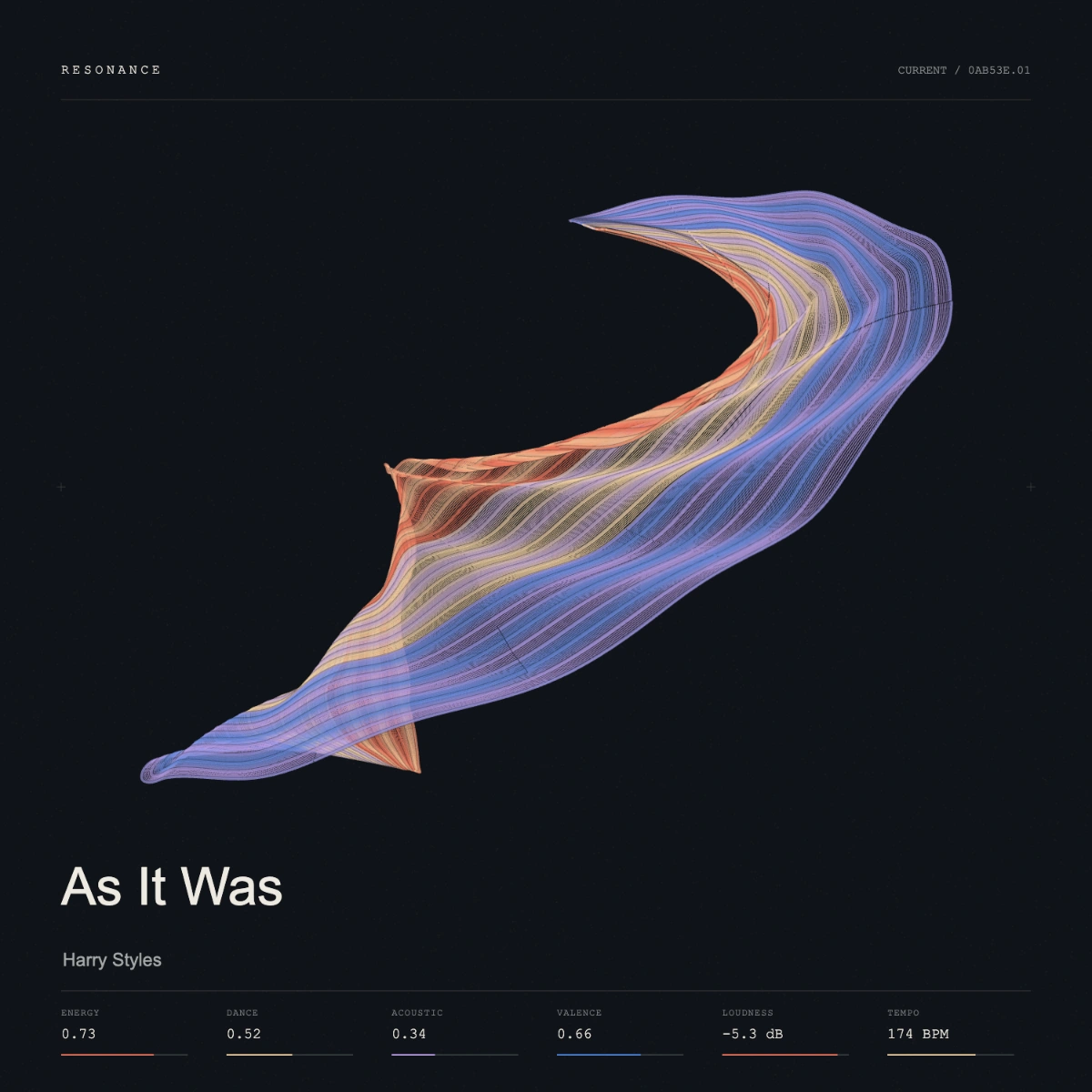
As It Was · Harry StylesStill frame
Hundreds of fine filaments become a dimensional sculpture. Seeded noise loosens the geometry into folds, ribbons, and delicate bands of color. The result has structure, with enough irregularity to feel alive.
Acoustic tracks lean toward an organic bloom. More danceable tracks form an orbit; the rest become a folded current. Each family keeps responding to all six features.
From sound to shape
Energy
More filaments and stronger turbulence.
Danceability
Repeating lobes and rhythmic symmetry.
Acousticness
Organic folds and wider ribbons.
Valence
Palette warmth and color balance.
Loudness
Sculpture size and filament contrast.
Tempo
Fine band frequency and the pace of motion.
02
Pigment
Loose hands. Wild color.
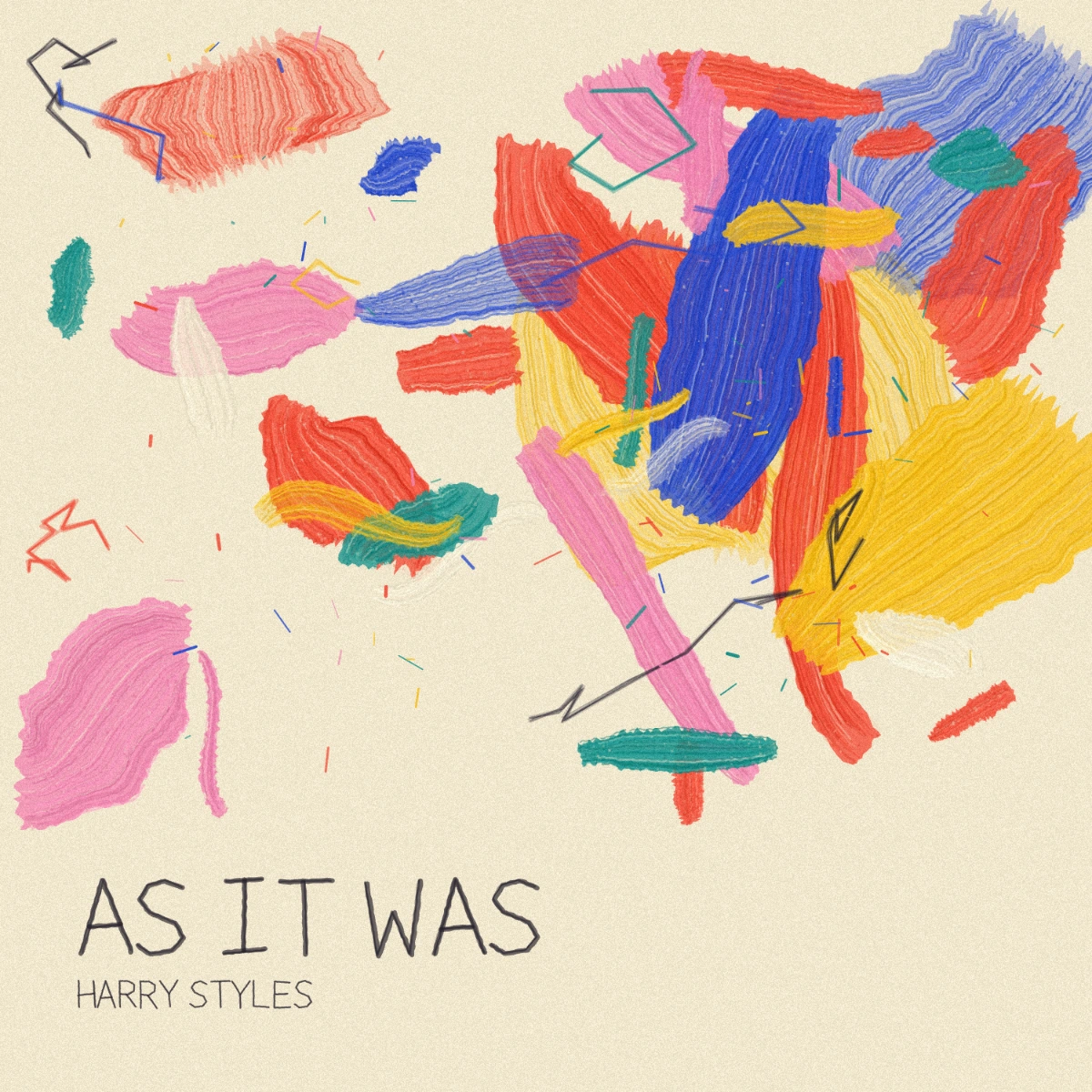
As It Was · Harry StylesStill artwork
A rough painting built from uneven gestures: translucent washes, dry bristles, scraped pigment, and flecks of color on grainy paper. Scattered marks keep the composition asymmetric and spontaneous.
Noise varies the pressure along each stroke. The title and artist are drawn with an uneven, crayon-like alphabet; other scripts use font fallback to preserve their characters. The painting stays still.
From sound to shape
Energy
More paint strokes and rougher edges.
Danceability
The direction and reach of each gesture.
Acousticness
Bleeding edges versus dry, scratchy bristles.
Valence
Palette warmth and subtle pigment shifts.
Loudness
Paint coverage and opacity.
Tempo
The number and length of small marks.
03
Classic
A softer first impression.
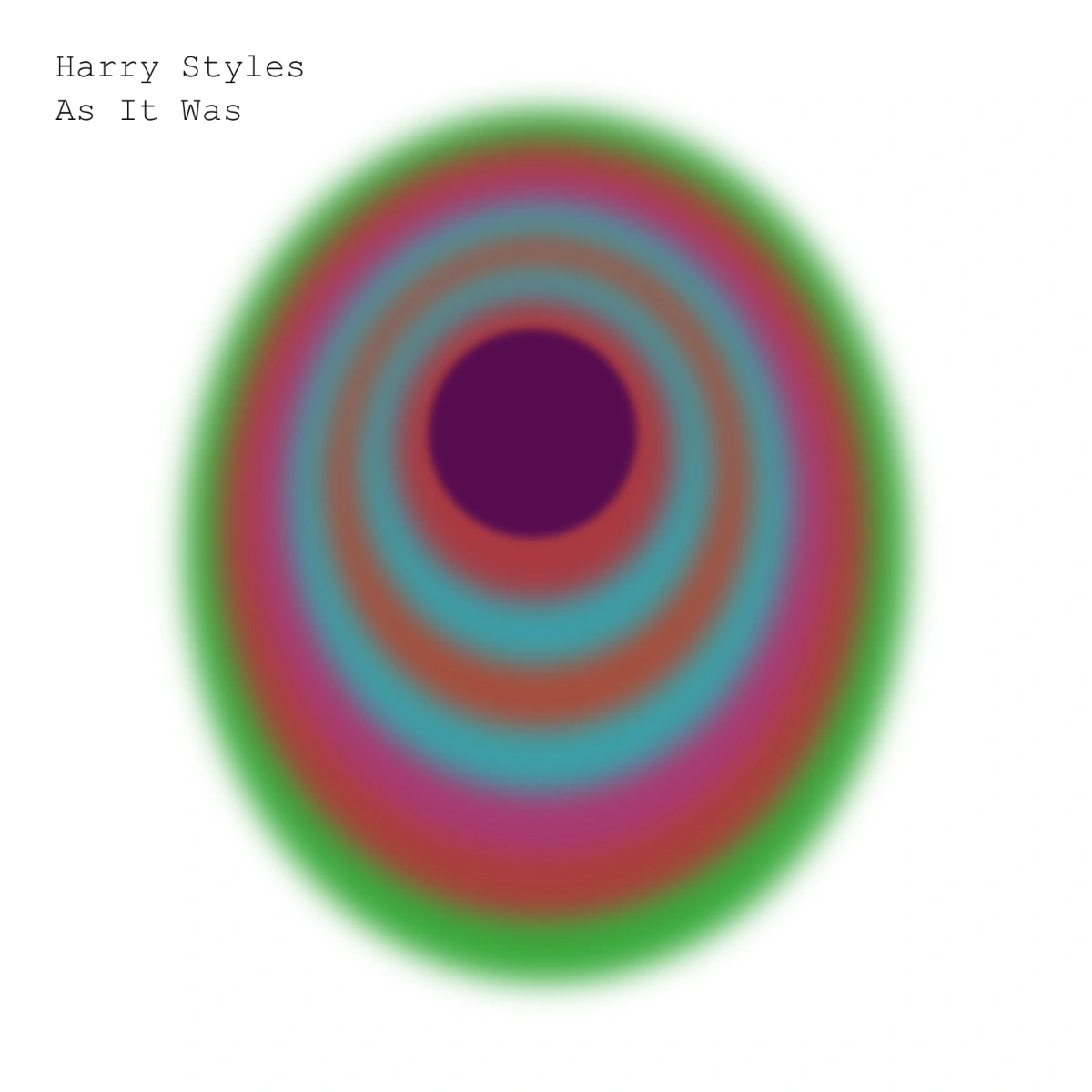
As It Was · Harry StylesStill artwork
The original study in blurred ellipses. Layers of color gather around a central circle, making a soft, spare composition from a small set of geometric rules.
Every feature has a direct role in the shapes. A little randomness in the layer colors gives each generation a different atmosphere.
From sound to shape
Energy
The direction of the shapes around the center.
Danceability
How far the shapes drift from the center.
Acousticness
The width of the ellipses.
Valence
Hue, saturation, and brightness.
Loudness
The size of the central circle.
Tempo
The number of overlapping layers.
A few details
The data. The drawing. The finishing touch.
Music data, honestly used.
Search uses the included catalogue of 114,000 records and their stored Spotify audio features. It isn’t a live Spotify search, so some songs may be missing. The six values guide the art; the app doesn’t listen to or analyse a recording.
Album artwork and release details come from Apple’s iTunes Search API when a matching song is available. They enrich the song summary and don’t change the poster’s audio features. Album covers stay outside the exported art.
A new variation, the same song.
In Resonance and Pigment, the song identity and edition number seed the fine details and composition. The same song and edition reproduce the same artwork. New variation changes that seed while keeping the audio values intact. Classic uses fresh color variation each time.
Made with code.
In the studio, Resonance and Pigment use p5.js noise to build organic variation. The renderer draws every line, stroke, texture, and grain of paper. The examples on this page were generated once and saved as images, so they stay the same on every visit.
Resonance can move gently in the studio. Tempo influences the pace; it isn’t playback or beat sync. Pause it whenever you like. Motion stops off screen and starts paused if your device prefers reduced motion. Classic and Pigment stay still.
Download PNG captures the current artwork at 1500 × 1500 pixels, including the exact frame of a paused Resonance poster.